ATV Tyres 101: Find the Ideal Fit for Your Ride
All-terrain vehicles can go where even some 4×4 vehicles can’t. With their power, compact size, and agile handling, ATVs offer a unique way to explore the outdoors and tackle remote terrain with ease. You can use one for work around the property or only when heading out into the bush over the weekend.
ATVs give you the ability to cover rough paths, haul gear and navigate through thick vegetation without issue. Be it going on an off-grid camping trip or just exploring the wild, the benefits of riding an ATV are most notable when you’re deep in nature and relying on your machine to get you to your destination and back home safely.
What Matters in an ATV Tyre
Size
Just like with any tyre, size matters, and if it isn’t matched to your ATV’s wheels, it can result in power loss or extra wear on suspension components. Having well-designed and large ATV tyres gives you more ground clearance, which is helpful when riding over rocks or through deep ruts. They’re better for mud and soft ground, too, where the added height helps keep components lower down from scraping. Smaller tyres offer better acceleration and low-end torque, but they can make your ATV less stable.
Ply Rating
The ply rating tells you how durable a tyre is. A lower ply rating, like 2 or 4, usually means the tyre is lighter and helps make for a more comfortable ride, as these tyres are suitable when you’re riding on flat grassy ground or smooth trails. Higher ply ratings, such as 6, 8 or more, mean the tyre is reinforced and built to handle rough terrain with sharp rocks and sticks. These ATV tires for sale are heavier but tougher, and the trade-off is worth it for the added peace of mind.
Bias vs Radial
ATV tyres are available in two main types, bias and radial. Bias-ply tyres have a criss-cross internal design, which is what makes the sidewalls more flexible and helps when riding at lower speeds, especially on uneven or slippery terrain. Radial tyres, on the other hand, have layers running straight across under the tread. These tyres are stiffer, especially the sidewalls, and are better for higher-speed riding and when carrying heavy loads. Radials tend to last longer and ride smoother, even when frequently riding over hard-packed surfaces.
Tread Pattern
The tread pattern is where you’ll notice a big difference between different tyres. Deeper, widely spaced lugs give maximum grip in mud, while shallow, tighter patterns are made for trail riding and packed dirt. If you get a tread that’s too aggressive for the surface you’re riding on, it can make the ride bumpier and more difficult to control. If the tread is too smooth, it can cause the tyres to lose grip on soft ground. Matching the tread pattern to the type of terrain you plan to ride on is important for both safety and performance.
Round vs Flat
Tyre shape also matters, with round-profile quad tires being better for loose trails and uneven ground, giving you more predictable handling and a safer ride. Flat-profile tyres have more surface area and are thus better for racing and on harder terrain where straight-line stability is needed. The tyre profile usually depends on your riding style and terrain.
Types of ATV Tyres
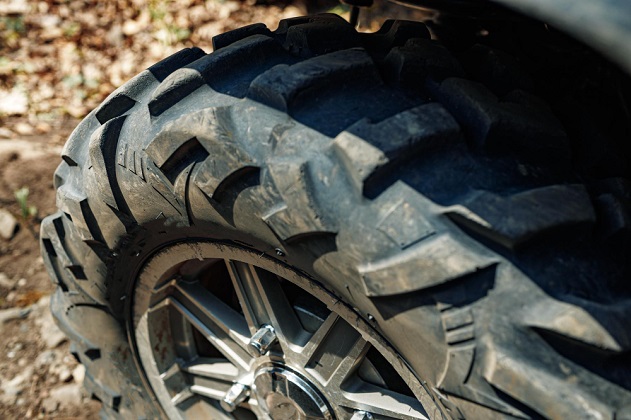
Mud
Mud tyres are the most aggressive as they have tall lugs with wide spacing for maximum traction when the path is both wet and soft. These tyres are built to dig into the ground and self-clean as they spin. On dry ground or pavement, though, they can feel rough and loud.
Trail
Trail tyres give you a balance between comfort and capability. That’s because these tyres are the standard option for general-purpose applications and thus work well across a mix of dirt, gravel and light mud. The tread is moderate in depth and spread, and the ride tends to be smooth over various surfaces.
Race
As you’d expect, race tyres are flat, lightweight and often come with a shallower, more directional tread. They offer excellent control and acceleration, which makes them ideal on smooth surfaces and dry, hard-packed trails. However, race tyres do wear out quite fast, which doesn’t make them suitable for rocks or gravel.
Sand
Sand tyres are built rather differently from the rest since they usually have a paddle design on the rear that helps your ATV float and push through soft sand. The front tyres often have ribs that aid with steering. These tyres don’t perform well on any other surface, except for dunes or when on the beach.
Pavement
Pavement or turf tyres are made for sealed surfaces. They have a flat profile and a smooth, shallow tread designed to avoid damaging lawns or biting into firm surfaces. Pavement tyres last a long time when used on rough surfaces, but struggle on loose ground or muddy conditions.
All-Purpose
A set of all-purpose quad tires is made to handle a bit of everything. They combine moderate tread and a shape that can adapt to a mix of different terrain surfaces. These ATV tires for sale are ideal if you often switch between trails, smooth surfaces and the occasional muddy path home. They won’t outperform any of the above, however, you can rely on them on most occasions.
About Author

ben